Wednesday, June 15, 2011

OVERPAINTED PHOTOGRAPHS OR PHOTOMINIATURES


One of the big drawbacks with photography in its early days was the
lack of colour.  This was overcome with hand colouring of the prints.
Sometimes the colourist was an artist who wanted to supplement his or
her income, or provide a cheaper alternative to a client. Some clients
specifically requested this service.  Others learned their trade at a
photographic studio.  Some colourists then went on to become
successful artists in their own right, including Walter Saunders Barnard, Ernest Widdas, Ada Whiting and Walter Herbert Wheeler (the latter artist becoming well known for his equestrian paintings. It is not known whether he painted miniatures)


Famous Swiss enamel painter John Graff specialised in the so-called Rajah watch portraits. 
 Few people realised that he was overpainting photographic images


Overpainted photograph by Katurah Collings
 showing the shadow of the photographic print underneath


Charming photominiature c.1905 by Arthur Hands


Two basically coloured photographs  probably of husband and wife 
c.1940 signed SM


Two cleverly coloured photographs c.1950 by Alan Shayle


In their day, there was no intention to deceive on the part of those who worked as colourists for photographic studios and on their own account.  However, at the height of the revival of the Grand Tour of Europe at the turn of the 20th Century, many prints were hastily overpainted and framed, usually featuring reproductions of Old Masters, and passed off as the real thing to unsuspecting tourists. Some were cheekily signed 'Reinolds' or 'Roi' or even 'Cosway'!
More recently, an overpainted photograph of a miniature of a soldier by Frederick Buck was allegedly sold at a UK auction as a portrait miniature painted on card!

Thursday, May 26, 2011

Stefanie's Miniature Collection


It is always fascinating to see what other people collect!
Stefanie from Canada has been collecting miniatures for 12 years.  She
is interested in the unusual and collects from all centuries.

Stefanie says, 'What I am missing is contact with other miniature collectors.'

 She would love to hear from other collectors to exchange news and views. 
Please email us if you would like to be in contact with Stefanie.


Wednesday, May 25, 2011

Identifying a sitter painted by William Wood (1769-1810)


This miniature by William Wood was purchased with the name of the sitter unknown


The only identification we had was the initial 'B' on the reverse

William Wood was very methodical in keeping records of his work and with a little bit of detective work it is sometimes possible to identify an unknown sitter


All images of William Woods records are
the copyright of V & A Museum London

The V & A Museum have five volumes of William Wood's records
 of which three list his portrait miniatures.


Wood, for some reason, numbered his miniatures starting at 5000
He had coded numbers for the different colours used on each miniature and also a chart for the different sizes of ivory ovals. Sometimes he made a tracing of the subject's profile. 
When a miniature was returned for repair he would have a complete record of  it.


We know our miniature is a man in a blue coat with the initial 'B' and 3 inches in height and from this we have the following possibilities.


Miniature number 5431. 'Mr Bruce of Sloane Street, in a blue coat, little powder in the hair -Thomas B
6th size being 3" finished 9th July 1796'

This is a possibility as it was painted around the right year and mentions the blue coat and powdered hair.


5483 'Mr Belcher of - in a blue coat - dark clear complexion
Finished 24th March 1797. 
Wood changed the coding of his sizes and 3 inches
 became between 1st and 2nd size!!

This is also a possibility, although it is debatable that the sitter's complexion could be described as dark.


5715 'Mr Bateman of Bunhill Row. Finished 16th Nov 1799.
Delivered same day. Dirty complexion. Blue coat of 141.
Ivory glass papered and washed.. Touches of 148 on eyes.
25 white. Mixed madder reds? Dark parts of 261. Not breathed on.'

Together with outline of coat similar to our miniature.
This is probably the most unlikely, as the tracing does not match the finished miniature in its positioning of the arm and shoulder and the cut of  the collar of the coat.  The sitter's complexion is even, so unlikely this could be the man with a 'dirty' complexion.


Finally Number 5754. 'Mr Byles of Halifax.
Began 25th Mar 1800 Finished 8th April. Delivered 10th.
Bilious complexion. 25 white. Mixed reds as usual.
Breathed on. Very slight touches of 148. Blue coat
of 141. Faint blue of 213 in background.
The ivory is scraped then rubbed with pumice.
Afterwards washed off.
In Sept. 1803 I found it had acquired some mildew while in the West Indies. 
And chiefly on those parts touched with 148 : perhaps breathing might be injurious!

This possibility is also unlikely because the Mr. Byles described here  has a bilious complexion and was not painted until 1800 and the miniature in question reflects a fashion previous to this date.

When Wood talks of 'breathed on' he is recording whether he breathed on the watercolour while painting to keep it moist while applying more colour.

So the possible sitters are:
 Mr Bruce 1796, Mr Belcher 1797,  Mr Bateman 1799 or Mr Byles 1800.

Taking all the details into consideration, we would consider that 'Mr. Bruce of Sloane Street'
 is the most likely candidate. Any comments would be appreciated.


Sunday, March 27, 2011

Richard Cosway (1742-1821)


Cosway was a prolific artist and at least one of his miniatures seems
to come up for sale in every major London auction.  However, his
drawings are not so often seen.  Even rarer are his oil paintings.


This oil painting, attributed to Richard Cosway, is the first we have seen
at close hand.  It could well be that because they are unsigned and
quite unlike his miniature work, they are not recognised.

When Cosway was training as an artist in London, he was said to have
painted erotic scenes on snuffboxes.  As far as we know, none of this
work has yet been discovered.


 However, some of his miniatures could
almost come into the category of erotic, such as this portrait of
 Lady Charlotte Sophia Leveson-Gower (later Duchess of Beaufort)
c.1787  Originally mounted in a gold box, this portrait was probably
painted for the benefit of her husband-to-be.


An unknown lady c.1785


 At one stage this miniature was probably mounted in a box, as indicated by
the instruction written in French on the reverse.  A smaller size
miniature of excellent quality, but not displaying the cloudy sky
background that became Cosway's trademark.


These next two miniatures are two classic 1790 miniatures with the famous cloudy sky background
 and signed in full on the back.


Unknown Gentleman.


The signature on the back with Cosway's Latin inscription stating he is
miniature painter to The Prince of Wales

Madame Marie Laubevinska, an opera singer.


Cosway output included a lot of pencil drawings, some of them coloured.

A pencil and watercolour drawing on card. dated 1796.  Either
Cosway never mastered perspective or else he deliberately elongated
the body for the sake of elegance.
  The face is very recognisable as by Cosway


A pencil and watercolour drawing on card.  c.1805  Earl
Harrington.  Rare signature on the back.  An extraordinary work,
reflecting the sitter's interest in magic and chivalry and his
obsession with Henry VIII.


Unknown Gentleman Signed and dated '18001'. 

 Cosway had never experienced writing
the numbers for the start of a new century and probably didn't know
how to 'start the year', hence the extra '0'. He was also rather
cheekily still using his elaborate signature with his boast of being
miniature painter to the Prince of Wales, which of course he was not
at this stage.  Horace Hone had been appointed in his place in 1795   .
This later miniature, in sombre colours is rather sad, as are all the
miniatures he painted in this 'grey' period, perhaps reflecting his
own state of mind.  Lacking the brilliant Cosway blue cloudy sky
background, his 'grey' period miniatures are never as eagerly sought
after by collectors


Saturday, March 12, 2011

William, John and Edward Naish


JOHN W. NAISH (1771-1852)
Born in Axbridge, Somerset, like his brother, William, he entered the
Royal Academy School on a six year course. The Royal Academy records
show that he entered the school on 18th February, 1791, aged 20 . It
is not known whether he completed the course.  He exhibited miniatures
at the Royal Academy from 1790-1795. He is also known to have painted
sporting subjects.  Apparently, a picture of a spaniel, signed and dated by him on
the back (what looks like 1791?) was sold at Sothebys on 21st November
1979 (Lot 23).
During his time in London, his known addresses are:

360 Oxford Street (1790/91)
464 Strand (1792/93)
25 Strand (1794/95)


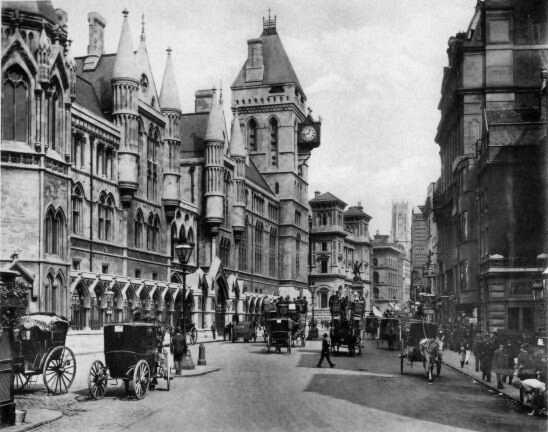
Oxford Street in Victorian times


The Strand in Victorian times


Like his brother, William, very few signed examples of his miniatures
appear to exist.  One, ostensibly signed on the back, is in the Dumas
Egerton Collection, now on long term loan at the Scottish National
Portrait gallery.  Sadly, we have no good image of this miniature and
to date have been unable to obtain one.


 By 1797, he is believed to have lived in Bristol at 27 College Green,
an address given on the back of a a miniature painted in that year.  A
few years later, c.1803, he painted the pair of miniatures below
whilst at 43 Princes Street, Bristol.  This address appears on his
trade card tucked into the back of the miniatures.


A pair of portraits c.1805 by John Naish when he was in Bristol.
Trade card on the reverse.  Copyright of the Victoria and Albert
Museum, London.


  Although the trade card does not mention the
christian name of the artist we know that his brother, William, died in 1800 and so strong
circumstantial evidence dictates that it is John.  It cannot be anyone
else as the trade card states that the artist is late of the Royal
Academy and records show that only William and John Naish attended the
Royal Academy school and exhibited there. Daphne Foskett states in her Dictionary and Guide that William Naish lived for a time in Bristol, but there is no evidence to support this and it is extremely unlikely to be so.  For one thing,  William  had a large and successful London practice, he is placed firmly at London addresses for all his adult life by his exhibits at the Royal Academy and he is always described as being a London resident by contemporaries.


Engraving of Isaac Ingall after John Naish

There are several known engravings after John Naish.  An engraving dated 1797
by John Yeartherd, after John Naish, of Isaac Ingall (1678 - 1798), a
strange looking portrait.  The sitter was famous for reputedly living
until 120!  He worked for the Webster Family at Battle Abbey, Sussex
for 90 years.
In 1805, The Gentleman's Magazine states that John Naish '...resides
in or near London' and was patronised by and a friend of the late Sir
Joshua Reynolds, under whom he studied portraiture.

In some reference books, it is stated that John Naish lived with his
brother, William, at one time, but there is no evidence to support
this, despite the fact that they both lived at the same address, but
at different times.  262 Stand, London was occupied by William Naish
between 1786-91 and by John Naish during 1792/93 according to Royal
Academy records.

The 1851 Census records John Naish as being married and still
practising as an artist, aged 80.  By this time, he had returned to
his home county of Somerset and was living as a lodger at 72 Silver
Street.  The head of the household was a Mr. Durban, an agricultural
worker and his wife, a laundress.  John Naish is recorded as having
died in 1852.


If anyone has a miniature or other painting by John Naish, or any further information, we would love to hear from you.