Monday, January 10, 2011

Dora Webb's Commissions For Queen Mary's Dolls House


The Dolls House is on permanent exhibition at Windsor Castle


Queen Mary, Queen Consort to George V, was fond of anything miniature.


 The King's cousin, Princess Marie Louise, had the idea to give her a
'miniature' present with a difference and commissioned a fabulous
dolls house.  The dolls house was to be a showcase for British artists
and craftsmen and took 1500 artisans three years to complete.  The
house itself - a grandiose four storey structure with working lights
and plumbing - was designed by the great architect Sir Edwin Lutyens
and was built on a scale of 1:12.  It was finished in 1924.


  Tiny rugs were designed and hand woven, leather bound books for the library
included new stories especially written by Sir Arthur Conan Doyle and
Somerset Maugham, and little bottles of wine for the wine cellar were
filled with the wine indicated on the label.


 The Foyer


The Dining Room


  Amongst the top artists,
miniature painter Mahala Theodora 'Dora' Webb received ten
commissions, including a 3.9. x 2.7 cm (approx 1" x 1.1/2")
portrait of Edward, Prince of Wales. 


Edward, Prince of Wales by Dora Webb
Hung somewhere in the Dolls House!

(The 'ARMS' after her signature referred to her associate membership of The Royal Miniature Society)


 Coming from a family of artists,
and with precocious talent, Dora Webb had a facility for painting
animals and landscapes as well as people
.


'Spot' by Dora Webb in our collection
painted in 1903


Two Poodles by Dora Webb in our collection
painted in 1959 


Sunday, January 2, 2011

Opening a Portrait Miniature painted by Frederick Buck


Where possible we always open up the frame holding a miniature.  It is particularly exciting
 if the frame is original and has never appeared to have been opened before.
We do this for several reasons.

 There is always the possibility that there might be information about the miniature inside, such as the identity of the sitter or perhaps a signature or note by the artist. Over the years we have made many exciting discoveries which have added to the historical value and interest of the miniatures. We refer to the occasions when we make a discovery as a 'bingo' moment. Apart from signatures or sitter's names we have found instructions from the artist to the framer and even  a record of the hours worked on the miniature and the price. Of course these 'bingo' moments don't happen every time and sometimes,  there is no further information inside.  

Another reason we like to open up a miniature frame is that it allows us to clean the various parts such as the glass underside (which on a miniature several hundred years old can be very dirty) and re polish the frame. The cleaning of the actual miniature surface, other than a light dusting with a very soft brush, should certainly be done by a conservator unless you have knowledge and experience in cleaning watercolour paintings.


 We have also found that some artists glued the ivory onto the backing support card with a strong glue which has resulted over many years in the ivory becoming 'bowed' and maybe even cracked. This is due to the differing expansion and the contraction rates of two dissimilar materials bonded together. A conservator is able to remove the backing board to release the ivory and allow it to return to it's original flatness. 


Finally, removing the miniature from it's frame  allows detailed photography, without the glass diminishing the quality of the photograph.


c.1805. An unknown gentleman by Frederick Buck.


This miniature was included with another in a lot we purchased at auction. We are not fans of Frederick Buck's work but he is a well known  artist. 


Born in Ireland around 1771, Frederick and his older brother, Adam, both became miniature painters. Frederick lived and worked in Cork and with soldiers leaving port to go to war he had a steady stream of clients wanting to leave their likeness with their loved ones or to take a miniature of their loved one with them. He had a production line of ivory blanks with various regiment uniforms already painted, waiting for the head of the sitter to be added, not always perfectly aligned!  His naive painting method is very recognizable and in fact is quite popular with collectors, especially his miniatures of red coated soldiers.  


In the above example , the gold frame was badly damaged.


The edge of the frame was badly bent in various places where someone had tried unsuccessfully to prise the frame open.


Here brute force had broken one of the connecting pins through the frame.


Frames are made in many different ways. A lot of the eighteenth and nineteenth century miniature frames were manufactured in two halves and kept together with brass pins around the edge. The pins in late nineteenth and early twentieth century frames are usually easy to extract because the pins have heads, but many frames have tapered pins around the edge and these are ground flush, such as with this miniature. It is impossible to open such a frame without removing the pins either by pushing them through the connecting frames or drilling them out. 


After removing the pins the frame was opened for the first time in two hundred years.


Here we show the various components of the frame disassembled

1 and 2 - Front and Back frame

3 - The miniature on ivory 

4 - Blue Bristol glass adornment for rear of frame.

5 - Backing pad for Bristol glass made from an old hand painted playing card.

6 - Centre compartment for rear of frame usually used for holding a lock of hair of the sitter.

7 - Backing support for the ivory made from an old trade card.


The backing support card in this case did not have any information on the sitter. It does have a  doodle, a coffee stain (?) and some numbers which look like 32000, 10000, £11 and 470.

Perhaps the £11 referred to the price.


A close up  under special light shows the quick coarse brushwork. 

Perhaps more caricature than other artists' work, Buck used a uniform pale grey/blue wash for the background and always a short, sharp line at the tip of the nose.


Having taken the miniature apart and photographed its components, we noted that the miniature itself was a little bowed.  We decided that the backing card had to come off,  as this would probably have caused it to warp.  This revealed an unexpected discovery! On the reverse of the ivory, Buck had made some bold embellishments, to an extent that we have never encountered before.  This is a little trick that some artists used to accentuate the colours of the miniature as the translucence of the ivory allows the reverse painting to show through. Clearly, the fact that the backing card was stuck to the ivory, demonstrates that Buck had thought his 'little secret' was safe!  If anyone else has a miniature by Buck with similar hidden 'attributes', we would love to hear from you.


Having now got to know him intimately, we have come to accept this frowning gentleman with startling blue eyes,  and decided to keep him as an example showing the typical work of a well known journeyman miniaturist.


Frederick Buck c.1771-1840


Friday, December 31, 2010

Horace Walpole's Strawberry Hill


HORACE WALPOLE'S 'STRAWBERRY HILL'

Horace Walpole (1717-1797) as the 4th son of the 18th Century British
Prime Minister Sir Robert Walpole, might have lived an inconspicuous
life if it weren't for his interest in collecting and writing, and his
astonishing transformation of a little villa in Twickenham!
Twickenham, about ten miles from Central London, was a two hour coach
ride from the capital in Walpole's day. Nowadays, it is a journey by
public transport of about an hour, by train, tube and/or bus and the
possession of an Oyster card.


2008 Strawberry Hill before restoration


2010 Strawberry Hill after £9million restoration


 Purchased in 1748, Horace Walpole spent
almost fifty years and £20,720 on its recreation as a 'little Gothic
Castle' into which he packed paintings, objects, books, curiosities
and sightseers and was credited with starting a Gothic Revival.  In
those days, the house was surrounded by fields and Walpole purchased
further land to augment the original five acre grounds to 46 acres.
From the top floor, there were views over the River Thames.  Nowadays
the views are interrupted by suburban housing. The walls of the
grounds abut the pavement and road in surprisingly close proximity,
and it is now hard to believe that the once magnificent villa was a
teachers training college in the 1920's before falling into almost
complete disarray.  A common problem with men who remain bachelors and
who have no offspring to carry on the 'tradition', on Walpole's death,
Strawberry Hill was left to a friend's daughter, Mrs. Anne Damer, and
was eventually inherited by the Waldegrave Family.  In 1842, the 7th
Earl Waldegrave auctioned off the contents of the house and Walpole's
legacy was scattered far and wide.  Walpole apparently relished his
position as an important collector and connoisseur and encouraged
visitors, although he made it clear that children were not welcome!!
Credited with being the first English collector to recognise the importance of the portrait miniature, he considered his collection of miniatures to be 'the largest and
finest in any country'!  We might be forgiven for thinking that he was
perhaps a little naive and presumptuous, when we consider the large
and fine miniature collections in many of the stately homes as
compared to Walpole's collection, which apparently numbered around
130!!  Walpole had a special miniature cabinet, measuring about 152 x
91 x 21 cm ( 60" x 37" x 8") made of rose wood and with ivory
ornamentation.  This cabinet is now in the Victoria and Albert Museum,
London.


Portrait miniature by William Grimaldi of Lady Hester Stanhope (After Joshua Renolds) c.1795

This miniature purchased with a label stating it was from the 'Strawberry Hill Collection'
 was once in our collection


 The Lewis Walpole Library at Yale University has
painstakingly attempted to track down all known former possessions in
Strawberry Hill, and their work to date can be seen online at
www.library.yale.edu/walpole.org.  The Victoria and Albert Museum held
a Strawberry Hill Exhibition earlier in 2010, and if you still have
the catalogue from that exhibition, you may like to keep it safely in
order to take advantage of the 'Two for One' offer for entry to
Strawberry Hill printed on the penultimate page.  This reduction may
help to assuage any feelings of disappointment that the refurbishment
of the house is still not completed (at the time of writing) and there
is no furniture or furnishings or gardens, and one is left to wander
around wearing plastic overshoes and a dodgy audio headset in timed
visits 20 minutes apart.  If you do not expect a mansion (the house is
quite small) but love gilding, stained glass, fantastical ceilings and a crazy
layout, the fabulous enthusiasm of the staff and the delightful
homemade fare available from the cafe will delight you.


 Hopefully, at some time in the future, Horace Walpole's Collections will be reunited
with his beloved Strawberry Hill and we shall be able to see what
visitors to his 18th Century house saw, that made him famous as a
connoisseur.  Nowadays, interest and connoisseurship in British Art is
promoted by the aptly named (but independent) 'Walpole Society'
(www.walpolesociety.org.uk), named after Horace Walpole, which
publishes a specialist volume each year in return for a modest
subscription.

Tuesday, December 14, 2010

Sir William Charles Ross 1794-1860


Painted by Ross c.1809.  Woman and Child as Venus and Cupid.  Apparently only fifteen when he painted this unusual and romantic composition, it is believed to be the first miniature that the artist exhibited at the Royal Academy, London.


Sir William John Newton (1785-1869), who taught Ross.   Miss Charlotte Cracroft (later Lady de Hochepied Larpent) c.1812. Master and pupil paint the same sitter, fourteen years apart.


Signed and dated 1826.  Lady de Hochepied Larpent.  Ross's mature style


Drawing  by Ross of Elizabeth Horrocks (nee Miller) c.1856, a few years before Ross's death in 1860.  Mrs. Horrocks was the sister of Thomas Miller, the industrial despot on whom Charles Dickens based Mr. Bounderby in his novel 'Hard Times'. This drawing is now in the Harris Museum in Preston. (www.harrismuseum.org.uk)


The details and images of Venus and Cupid and Mrs. Horrocks are courtesy of Mr. Andrew Sim (www.simfineart.com) to whom we offer our thanks.

Saturday, November 27, 2010

An Invitation to Buckingham Palace


A few weeks ago, we heard that The Royal Collections had purchased a copy of our book, ‘THE ARTURI PHILLIPS COLLECTION: A Catalogue of Portrait Miniatures’. We were also invited to a reception at Buckingham Palace. The envelope duly arrived, unmistakably with a postmark
'Buckingham Palace' although it was sent from the office at St. James PalaceThe Royal mail is collected from the palaces by liveried coachmen in one of the royal coaches and taken to the sorting office! This is to exercise the horses and to get them used to the busy London traffic. 
In a rather unexpected modern twist, we were invited to RSVP by email!!  Which we did!!  There was a ripple of excitement in the art world at the prospect of the reception, and a lot of guessing and second
guessing as to who had been invited.  The occasion was held to mark the publication of the catalogue of H.M. The Queen’s Victorian Miniatures – over 1000 of them – photographed and catalogued by the Queen’s Assistant Curator, Vanessa Remington, who had access to Queen Victoria’s diaries and papers.


  For those of you not invited, you will be pleased to hear that it was not a lavish affair. There was no dress code, but nearly all the gentlemen wore dark suits. Guests were greeted, without fuss, by smiling uniformed attendants, both men and women, from all age groups and backgrounds.  There was not a whiff of security anywhere.  And certainly no X-Ray scanners or handbag searches!  The sumptuous exhibition, Victoria & Albert: Art and Love  - recently extended to run until end December by popular demand – was a fitting backdrop  to the intimate world of the miniature artform.


With Christmas in prospect, Roger promply put the ornate carved ivory throne encrusted with diamonds, rubies and emeralds on his ‘wish list’ , presented to Queen Victoria in 1851 by the Maharajah of Travancore.


Carmela settled for Sir Edwin Landseer’s  gorgeous portrait of  Victoria, the Princess Royal, with Eos nuzzling her little foot, commissioned by Queen Victoria in 1841 to give to her husband, Prince Albert for his birthday. 


On arrival, we were offered a choice of a glass of  chardonnay  or lemon and lime fizz.   Miniscule little mouthfuls of food were served, without plates, cutlery or napkins, throughout the reception on little oblong glass trays, underlit and with pink and white lilies in the bottom compartment.  Mini lamb burgers in tiny bread baps  topped with goats’ cheese, quails eggs and dips, little quiches and tartlets and other dainty morsels. 
Vanessa Remington came over to talk to us, dressed in an elegant black dress. She spent eight years cataloguing the Queen’s Victorian miniatures, taking time out to have three children! ‘Insiders’ had expected HRH Prince Charles to attend.  He is known to be particularly interested in miniatures and is Patron of the Royal Miniature Society.  In the event, there was no representative from the Royal Family, but this did not dampen the enjoyment and enthusiasm of participants.

  Amongst the invitees, who made up a veritable Who’s Who of the Art World, were the legendary Sir Roy Strong, sporting a new look, almost unrecognisable, looking more like an older rock star than an art historian and former Director of the Victoria and Albert Museum, Alan Derbyshire, who is in charge of conservation at the V & A, Bernd Pappe, author and conservator of miniatures at the Louvre Museum.  Of course the well known miniature dealer and connoiseur, David Lavender and his wife, Patricia, had been invited, as were the experts from all the major auction houses. 

  We were introduced to several decendants of famous artists, including the friendly and enthusiastic Henry Engleheart , the great nephew of the 'great' man himself, George Engleheart.  During conversation we embarrassingly discovered that we had been bidding against him in  an auctions as he tried to regain his ancestor's fine work!  He and his wife generously took no offence and continued to chat to us amiably.  The evening resulted in many invitations and renewing of acquaintance.   Proceedings were discreetly brought to a close when staff circulated to collect wine glasses, murmuring ‘thank you’s’ and wishing guests ‘goodnight’.  


Sunday, November 21, 2010

Ten Modern Day Masterpieces

Who says miniature painting around the turn of the 20th Century was dead? Here are ten miniatures, all painted between 1890-1927 that we would consider exceptional


1901 Miss Mason painted by Ellen Louisa Stansfeld on ivory


1895 Miss Olga Cartwright Dickson painted by Alice Mott on ivory


                   c.1890 Mrs. C. A. Goodday painted by Hugh Nicholson on porcelain


c.1895 Two brothers painted by Lillian Wright on ivory


1907 A Champion Boxer painted by Amy Gertrude Chamberlin on ivory


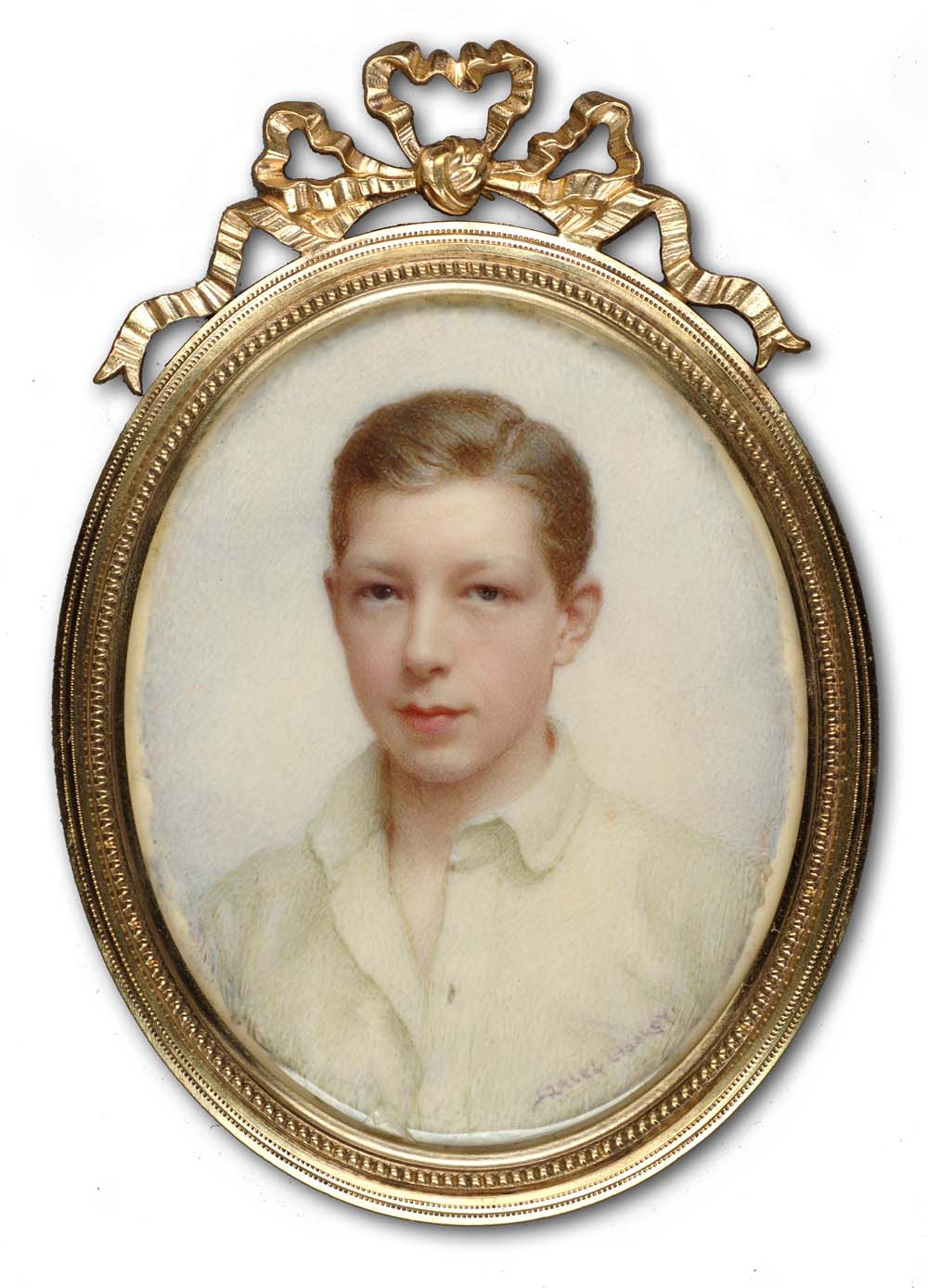
c.1895 A Young Man painted by Mabel Lee Hankey on ivory


c.1895 Mrs. Yardley painted by Carlotta Nowlan on ivory


1918 Miss Frances Weir Cuthbert painted by Ethel C. Bailey on ivory


c.1910 A Spanish Toreador painted by Miss Blanche Hacker on ivory


1893 Master William George Barnes aged 6 painted by Robert Henderson on ivory


Tuesday, November 9, 2010

John Graff 1836-1903 (Swiss) enamel portrait miniature painter


A 'Rajah' pocket watch by Marcks & Co. Ltd. c.1895

 During the latter half of the nineteenth century, a number of Swiss artists painted enamel portraits to be mounted into heavy gold pocket watches for the Indian Market. The watch movements were usually complicated and with as many decorations as possible and were made by companies like Marcks & Amp. Co Ltd. with the enamel miniature of the owner mounted on one side and the watch face on the other. These pocket watches became known as 'The  Rajah Watches'. 

 The watch movements were mainly produced by the highly specialised watch manufacturers in the Vallée de Joux or Le Locle and delivered to the case makers in Geneva. The cases were almost exclusively done in the workshops of Ferrero, Tardy, Bonifas, Giron and Lamunière, based in Geneva. Important Indian clients often supplied the diamonds and other precious stones to be set onto their watches.


Some years ago we purchased one of these enamel portraits, signed 'JG', (without the watch!) and we had no idea what we had purchased until we were kindly supplied with the vital information by Roni and later Julian, two very kind gentlemen who put us on the right track.  The enamel portrait shown above is of HH Maharaja Rajendra Singh Bahadur of Patiala  and is signed by  John Graff.

John Graff worked from  photographs sent from India and was the acknowledged master in his field. He became one of Geneva's most famous enamel painters who was said to be able to catch 'an incredible likeness even from the most mediocre documents'. He was also renowned for his sense of colour and the astonishing relief of his work. John Graff's fame quickly spread throughout India and the dignitaries would often request his signature on the watches and boxes they ordered. His works were signed "J. Graff" or "J.G." or "Graff".  However, he was harbouring a secret method of working, which only becomes obvious with high magnification!

Five examples of "Rajah Watches" with enamel portraits of high dignitaries signed John Graff are illustrated in
Technique and History of the Swiss Watch" by Eugène Jaquet & Alfred Chapuis, plate 133.


Enamel miniature painting by John Graff from a Marck & Co pocket watch
from our collection Signed J. G. Date c. 1895
Sitter: Mir Ali Khan Mehoob, Nizam of Hyderabad


Close up detail showing John Graff's superb talent but also showing that the likeness was achieved by over-painting a photograph developed on the enamel base. Some of the 'giveaways' are the shadow under the red of the nostril, the faint shadow of the photograph on the lips and the halo around the face 'blending' the brushwork and the photograph.  Perhaps you can see some other clues if you look carefully! This developing process was invented by Paris photographer Lafond de Camarsac (1821-1905) around 1867, for which he won a Medal.


On the back is stamped '18 carat' and M & Co Ltd
Interestingly a number is scratched under the stamping
'2673' which could have been a reference for which watch this enamel was intended. Alternatively, it could be the serial number of the patent granted for the development of the photographic image.


Another image of the Nizam of Hyderabad, showing the portrait in the watch.


Close up of enamel photominiature shown in first illustration.
A few more examples of 'Rajah' watches and an enamel photominiature in an elaborate gold box shown below.


Our grateful thanks to Roni Madhvani for sending us these additional images and allowing us to use them.